Nature Notes
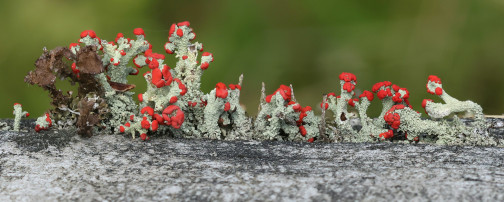
PHOTO COURTESY OF GARRY KESSLER
British soldier lichen (about one inch tall), in a close-up, side view
August 12, 2026
NATURE NOTES
By Annie Reid
Westborough Community Land Trust
British Soldier Lichen – what is it?
When walking trails or sidewalks, many of us look down, scanning the ground ahead. Other than avoiding trips and falls, this habit makes it easy to spot interesting things that grow. Next to a path, for instance, you might see numerous tiny red caps of British soldier lichen (Cladonia cristatella). An odd name? Those eye-catching red caps must have reminded folks of the British “red coats” who fought our famous Minutemen in the American Revolution.
What you’d typically see is a patch of little red caps against a flat, scale-like, gray-green background. Shaped like balls, the red caps sit on tiny, branching, tree-like stalks, usually less than 1 inch tall. Look for British soldier lichen growing on soil, wood, tree bark, or even old telephone poles.
What’s a lichen, anyway? Hint: it’s not a plant, although you’d be forgiven for thinking it’s one. A lichen is actually a combined organism. You may have heard of such a thing, but not everyone has. It’s created through a partnership between a fungus and either algae or cyanobacteria (formerly called blue-green algae). In short, think of British soldier lichen this way: the fungus builds the house, the algae make the food, and a legion of British soldiers emerges.
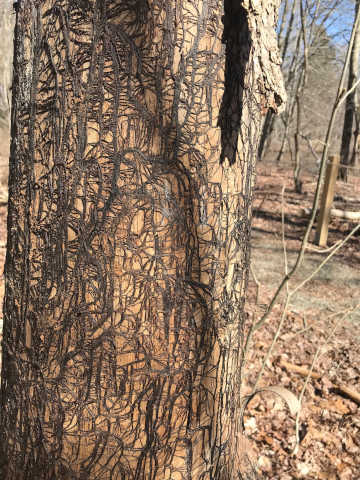
Script lichen on tree bark
In a lichen, the algae live within the tissues of the fungus. The cells of the two species, fungus and algae, connect via hairlike tubes that the fungus sends to the algae. The two exchange substances through the tubes. The fungus shelters the algae and supplies water and nutrients (nitrogen, phosphorus). The algae have green chlorophyll and make carbohydrates using energy from sunlight. They send carbs to the fungus. The algae also give the lichen its greenish color. Working together and growing as one organism, the two very different species can do things and survive conditions that each on its own might not.
In British soldier lichen and other lichens, the partnership between fungus and algae is usually viewed as benefiting both partners – a mutualism. Yet there are other views. One is that the algae are taking advantage of the fungus, like parasites. Or maybe it’s the other way around, fungus taking advantage of the algae. Yet another view is that the fungus is, in effect, farming the algae (or cyanobacteria) for food. When you’re bored, have fun thinking about all that!
What are those little red caps for? They’re all about reproduction. They’re sort of like mushroom caps. Spores develop inside the balls and eventually get released from them. The spores spread the fungus part of the lichen. If a spore lands near a suitable species of algae, a new British soldier lichen can form and develop.
Does the red color of the balls help somehow? There’s no sure answer. The red color might protect the spores from strong sunlight. Or it might attract animals to nibble the lichen and spread spores. White-tailed deer, for example, do eat British soldier lichen. Or, on the other hand, red is often a warning color in nature, and the lichen is very acidic. Perhaps the red color helps to keep the spores from being eaten. Needless to say, further study is needed.
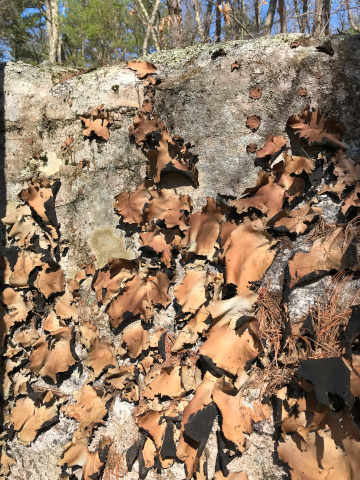
Fallen leaf lichen growing on a boulder
British soldier lichen and other lichens also spread in another way. Due to wind, rain, ice, snow, or disturbances by animals including insects, small bits of lichen can break off. These bits might end up nearby or elsewhere. Bits that include both fungus and algae can develop into a new British soldier lichen. It will be genetically identical to the one that the bit came from.
Lichens, including British soldier lichen, grow very slowly, but they are long-lived. They also can survive very harsh conditions. Lichens tolerate drying out, direct sunlight, cold, and even freezing.
What’s their secret? They go dormant. In other words, they turn themselves off, and then turn themselves back on when conditions improve. Such abilities make them of interest to science. Lichens (though not specifically British soldier lichen) have even survived in outer space. For example, a lichen lived 18 months on the outside of the international space station.
What’s bad for lichens? Pollution, especially air pollution. Various lichens can be sensitive to high levels of nitrogen (from fertilizers), sulfur dioxide (industry, fossil fuels), heavy metals (copper, lead, zinc, mercury), fluorides, ozone, or acid rain. Different lichens have different sensitivities. For this reason, they can serve as indicators of air quality. In general, if you find lichens in a natural environment, you know the air quality is fairly decent.
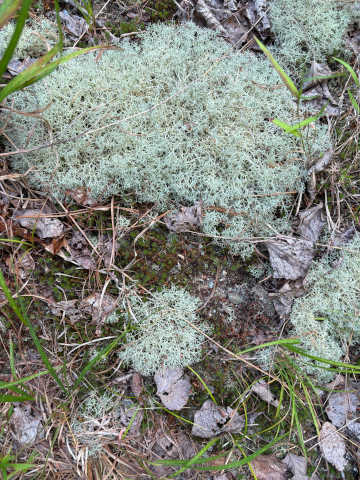
A local lichen growing on the ground
British soldier lichen is a common name. Beyond that, there are scientific names. British soldier lichen typically includes the green algae Asterochloris erici (formerly Trebouxia erici). The fungus is Cladonia cristatella, and this scientific name is also used for the lichen. (Scientists give lichens the same scientific name as the fungus in the partnership.) Working in New England, an American botanist and professor at Amherst College, Edward Tuckerman, first described British soldier lichen in scientific terms in 1858.
Many lichens grow in our region. Check big rocks for lichens that look like fallen leaves. They have names like fallen leaf lichen or rock tripe. Look on tree trunks for script lichen. New England has at least 461 different lichens of a size that you might spot. Other lichens with red caps exist, but British soldier lichen is probably the one you’d see here.
Do lichens make you curious about the idea of organisms combining to form new, different living things? It’s not necessarily science fiction. Today’s animal and plant cells have internal parts (mitochondria, chloroplasts) that may have originated from ancient cells absorbing bacteria with special abilities. Billions of years ago.
Enjoy the cool woods this summer. (And check yourself for ticks.) The more you know about nature, the more interesting it becomes.