Nature Notes
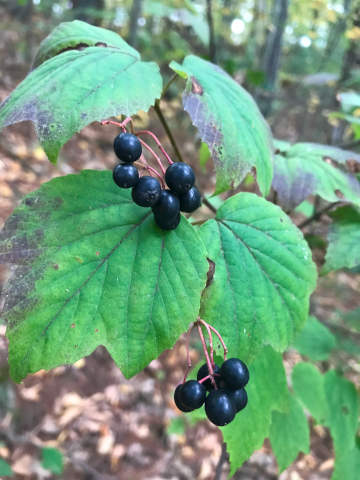
Maple-leaf viburnum with berries in fall
July 10, 2026
NATURE NOTES
By Annie Reid
Westborough Community Land Trust
Maple-leaf viburnum: a native shrub in our woods
We can have fun admiring the shrubs in local yards, but what about the shrubs in our local woods? How often do we think about them? Many are native plants. Like the one called maple-leaf viburnum (Viburnum acerifolium), they tend to be noticeable, yet not as eye-catching as many popular garden shrubs.
You might spot maple-leaf viburnum along the side of a trail or near a stream. It’s a low, woodland shrub, about waist-high or so. It’s noticeable in different ways in different seasons. In the now-bygone days of spring, it bears flat clusters of tiny white blossoms. In summer, its berries gradually ripen, turning from green to red to dark purple or blue-black. In fall, its foliage becomes rosy-red to purple.
Then there are the leaves. This shrub isn’t called “maple-leaf” or “maple-leaved” for nothing. It’s easy to see that its leaves bear a resemblance in shape to maple leaves. Most New Englanders recognize maple leaves, with their distinctive three or five lobes. Red maples (Acer rubrum) have three lobes. Sugar maples (Acer saccharum), Norway maples (Acer plantanoides), and silver maples (Acer saccharinum) have five lobes. Maple-leaf viburnum leaves usually have three lobes, either rounded or somewhat pointed. Also, you can see that like maple trees, maple-leaf viburnum leaves grow in pairs, opposite one another.
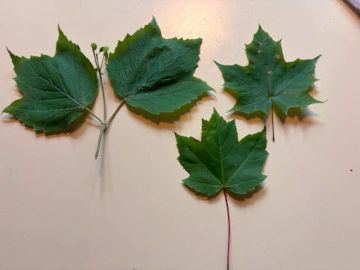
Leaf comparisons: (Left) a pair of maple-leaf viburnum leaves, with beginnings of berries on stalks in the middle; (lower right) a red maple leaf; (far right) a Norway maple leaf.
Maple-leaf viburnum is shade tolerant, so you’ll usually find it in older woods with tall, leafy trees, such as maple, beech, oak, or hickory. It thrives in partial or full shade, where it makes up part of the forest’s shrub layer. Layers? You don’t have to be an ecologist to think of a forest as having various layers. Commonly recognized layers include the canopy (tops of the tall trees), the understory (shorter trees, young trees), the shrub or brush layer (woody, often multi-stemmed plants), the herb layer (soft-stemmed plants such as wildflowers), and the forest floor (leaf litter and ground covers).
As a native plant, maple-leaf viburnum has interactions with other local forest-dwelling plants and wildlife. At different times of year, maple-leaf viburnum has different roles and contributions in the overall life of the forest. In winter, as part of the shrub layer, its twigs can be food for rabbits, mice, and deer. Maple-leaf viburnum is considered somewhat deer-resistant, so it may not be a deer’s first choice, but it’s there if needed.
In spring, its flowers offer nectar and pollen to various pollinators. These visitors include wild native bees, such as sweat bees and mining bees – which don’t live in colonies or hives, but make their homes in single holes they dig in the ground. Other pollinators include flies, beetles, wasps, and butterflies. Maple-leaf viburnum is also one of the host plants for spring azure butterflies, whose caterpillars feed on its leaves once they hatch from eggs laid on the host plant.
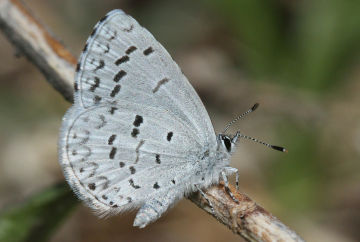
PHOTO COURTESY OF GARRY KESSLER
Maple-leaf viburnum is one of the host plants for the spring azure butterfly.
In late summer into fall, ripe maple-leaf viburnum berries become food for wildlife. These pea-sized berries are “low-quality fruit,” meaning that they contain only small amounts of fat (less than 10% of this energy-packed nutrient). They don’t rot quickly, and they get eaten gradually. Birds that eat them include robins, cedar waxwings, brown thrashers, gray catbirds, wood thrushes, hermit thrushes, wild turkeys, ruffed grouse, and ring-necked pheasants. Deer, rabbits, chipmunks, mice, squirrels, and skunks also take the berries. Are the berries considered edible for humans? They’re bitter, and the short answer is no.
Birds and mammals spread maple-leaf viburnum seeds far and wide in their droppings. These animals enable the shrub to grow in new places, but the shrub also spreads by underground suckers. The suckers give the shrub a way of taking advantage of its current location, even in years that aren’t particularly good for pollination or berries. (Think of cold, wet springs or summer droughts.)
Historical Native American uses for maple-leaf viburnum involved medicines made from the bark, roots, or leaves.
Does maple-leaf viburnum have any enemies? There is one, an invasive insect from Europe, the viburnum leaf beetle (Pyrrhalta viburni). Its larvae can eat the leaves down to skeletons, leaving only the ribs or veins that you see, damaging the plant. In North America, the beetle has escaped the predators and diseases that keep it in check in Europe.
What about look-alikes? Maple-leaf viburnum is closely related to other viburnums, but only one other has maple-like leaves. It’s called cranberry bush viburnum (Viburnum trilobum) because in fall it bears obvious clusters of large, bright red berries that remind people of cranberries. It’s not related to cranberries, though. Its tart berries are sometimes used in jelly, jam, and sauce. In spring, it has clusters of small white flowers, surrounded by a ring of larger blossoms.
Enjoy a cool walk on trails in the woods this summer, keeping an eye out for maple-leaf viburnum and its look-alike. Appreciate the interconnections among the living things of our woods. And remember to check yourself for ticks.