Nature Notes
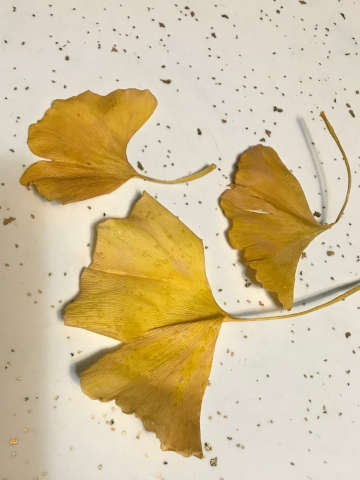
Fallen yellow ginkgo leaves on the ground, November 14, 2025
October 10, 2026
NATURE NOTES
By Annie Reid
Westborough Community Land Trust
Ginkgo tree – a survivor & living fossil
The ginkgo’s leaves are distinctive. They are fan-shaped, so especially easy to spot on the ground. Their triangular shape is related to the forking pattern of the leaf veins, which fork but do not make interconnections to form a network. The leaves grow in small clusters of 3-5, from short spurs. In late autumn, the green leaves turn golden-yellow.
If you find a ginkgo, keep your eye on it this fall, if possible. Many local trees typically lose their fall foliage gradually, but the ginkgo is famously different. It’s known for dropping all its yellow leaves suddenly, at once, over a few days or even overnight. This leaf-fall usually happens in November, probably triggered by a serious frost.
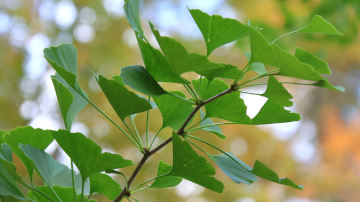
PHOTO COURTESY OF GARRY KESSLER
Still-green ginkgo leaves in clusters on a tree, October 9 2026
A short poem, “The Consent” (1974) by Howard Nemerov, celebrates this leaf-fall. The event also figures in the plot of a recent detective novel, Red Verdict, by James Comey (former FBI director).
A ginkgo tree is tall – up to 40-70 feet – with branches sticking more or less straight out. The sexes are separate, so ginkgo trees are either male or female. They are wind pollinated. Male trees produce pollen in small cones in March-April. Female trees bear seeds August-November. The seeds have a fleshy coating that’s light green in summer but turns yellow or orange in fall.
In Westborough, you can see a ginkgo tree in a small island at the intersection of Mt. Pleasant St. and Warren St. (That’s just off Rt 135 east, shortly before the turn-off to Upton Rd.). The ginkgo is in a lovely garden setting containing memorial plaques for three individual Westborough service members who gave their lives for their country in WWII and Vietnam. The tree’s leaves were still green in early October but are likely to turn yellow and drop in early November.
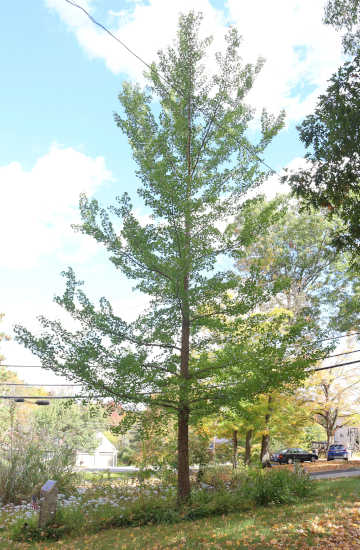
PHOTO COURTESY OF GARRY KESSLER
A ginkgo tree in Westborough, in a small memorial garden at the intersection of Mt Pleasant St. & Warren St.
The modern ginkgo (Ginkgo biloba) is native to eastern Asia, where its ancestors have a history going back to times before the dinosaurs, 270 million years ago. Today’s ginkgo has been cultivated in China for hundreds of years, perhaps more than a thousand. A couple of small wild populations still exist there. The ginkgo is also widely cultivated in Korea and Japan (since the 1300s). It has been planted in places around the world.
The ginkgo was introduced to Europe (Netherlands) around 1730, and to North America (Philadelphia) in 1785 – around the time of the American Revolution. Ginkgoes are long-lived. One of the three ginkgo trees first planted in Philadelphia still survives (at Bartram’s Garden). It’s the oldest ginkgo in the U.S. The other two were cut down 40 years ago to make room for other purposes.
Why is the ginkgo called a living fossil? The modern ginkgo (Ginkgo biloba) is now the only one of its kind – that is, the only living species – in the gingko family (Ginkgoaceae). All close relatives are extinct, but there is evidence of them in the fossil record. The Ginkgo biloba genome was sequenced in 2016 in China.
The ginkgo is good at surviving. Amazingly, six ginkgo trees survived the bombing of Hiroshima, Japan (1945), within about a mile of the blast. They were largely destroyed but then sprouted from their bases. Three of them are still growing today, and are marked by signs.
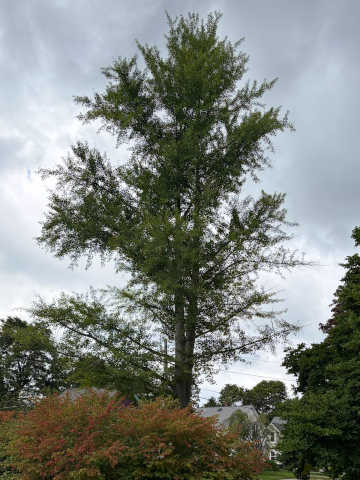
Silhouette of a ginkgo tree in a Westborough neighborhood
What makes the ginkgo such a good survivor? These trees are adaptable and often grow in disturbed environments. They can grow in confined spaces and in soils that are acidic, alkaline, or even compacted. They tolerate pollution, heat, and salt. They also resist diseases, insects, and other pests. Their wood is rot-resistant and fire-resistant. Not surprisingly, they’ve been used as street trees and urban ornamentals. Perhaps it has also been good for their survival that humans have cultivated them for centuries.
But, you might wonder, is this non-native tree likely to spread aggressively and become invasive here? No, it seems that the ginkgo (Ginkgo biloba) is not invasive. It seems better at surviving than at spreading. It is not listed as invasive anywhere in the U.S. That’s unlike more familiar non-native trees such as Norway maple (Acer plantanoides) and tree-of-heaven (Ailanthus altissima), both listed by Massachusetts as invasive. Although ginkgoes produce plenty of seeds, and can also spread via aerial roots, they seem tame when it comes to spreading.
Are ginkgoes too good to be true? Not quite. As it turns out, the ripe seeds (sometimes called “fruits”) that fall on the ground are messy and have an unpleasant odor (due to butyric acid in their fleshy coating). For this reason, nurseries and programs offering trees to the public (such as Massachusetts’ Greening the Gateway Cities program (GGCP)) typically provide only male ginkgo trees. Male ginkgoes do have drawbacks, though. Like other wind-pollinated plants, their pollen can cause allergies in some people. At least seven cultivated varieties of Ginkgo biloba exist.
People have found various uses for ginkgoes over the years. Ginkgo nuts – the seeds without their coating – are ingredients in some Chinese dishes. Seeds and leaf extracts have used in traditional Chinese medicine. Leaves and seeds have also been a source of yellow dye.
Westborough has at least 10 ginkgoes. Consider visiting Mt. Auburn Cemetery in Cambridge, a garden cemetery that has more than a dozen ginkgoes, or Arnold Arboretum
Date index
Month (October)
Common name index
Scientific name index
Category index