Nature Notes
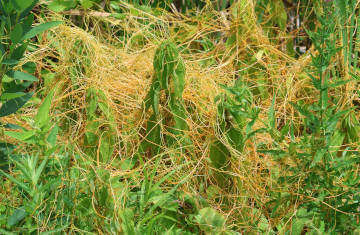
PHOTO COURTESY OF GARRY KESSLER
Who dumped spaghetti on these plants? What’s this tangle of orange stems? Here’s common dodder, a parasitic plant and serious agricultural pest of cranberry crops.
June 12, 2026
NATURE NOTES
By Annie Reid
Westborough Community Land Trust
Play the “what’s-it” game in nature this summer
“What is it?” That’s a fair – and fun – question to ask when you find something strange in your local natural environment. For example, you might ask that question if you come upon what looks like a heap of long, tangled strings or a pile of thin yellow-orange spaghetti.
If you guess that it might be a plant, you’re on the right track. But it seems to be odd, as plants go, with no leaves to be seen, and no green color. And maybe no roots?
If you know or have heard that some plants are parasitic – either totally or partially parasitic – you might suspect that this “what’s-it” is parasitic. Without green chlorophyll to make its own carbohydrates using sunlight, carbon dioxide, and water, it needs a different way to get nourishment. Maybe take it from other living things?
This “what’s-it” looks long and skinny, so you might think of a vine, rather than a tree, bush, grass, or wildflower or weed.
As it happens, this “what’s-it” is indeed a vine, and a parasitic one at that. Known as common dodder (Cuscuta gronovii), this vine grows throughout much of the U.S. It’s a native plant. It’s in the morning glory family (Convolvulaceae) of annual and perennial vines.
As a member of the morning glory family, it’s related to other vines that have green leaves and are not parasitic. Among its relatives are morning glories (Ipomoea purpurea) and field bindweed (Convolvulus arvensis), which looks somewhat like morning glories. Would you believe dodder is also related to sweet potatoes (Ipomoea batatas), also in the morning glory family?
How can dodder get along without roots? It turns out that it only has roots at the very beginning of its life, just after sprouting from seed. The seedling’s stem grows quickly and begins to turn in a counter-clockwise direction. When the stem touches another plant, it starts twisting around that plant, which becomes its host. The dodder’s roots die off, no longer needed, as special suckers (haustoria) develop. They absorb water and nutrients from the green plant and move them into the dodder. The parasitic dodder now lives off the other plant. Dodder thrives, branches, and spreads, becoming the tangle of stems that you spotted.
Dodder’s habit of twisting and twining around other plants has given it names such as love vine and love tangle. Still other names are strangle weed, swamp dodder, golden thread, and angel’s hair.
How long do these parasitic plants live? Seedlings die after 3 to 9 days if they don’t find a host. Otherwise, as an annual, dodder usually doesn’t survive winter. Sometimes, if the host plant has a live woody stem, some of dodder’s suckers (haustoria) may have grown far enough into that stem to be protected until spring. Then they sprout new dodder plants.
In July-October, you might find dodder not just as a tangle of stems. It might be blooming with clusters of tiny (1/8-inch long), waxy, white flowers. Wasps visit the flowers and may pollinate them. Late in the season, you might see on the vine some small, round, orange capsules, each containing four tiny seeds.
Where are you likely to find dodder? Keep in mind that it’s sometimes called swamp dodder. Look near water and in areas with moist ground.
In late spring or early summer, likely hosts include narrow-leaved goldenrod (Euthamia tenufolia, Euthamia caroliniana) and swamp yellow-loosestrife (swamp candles, Lysimachia terrestris, not related to purple loosestrife). There’s also another dodder species, buttonbush dodder (Cuscuta cephalanthi). It mainly uses buttonbush (Cephalanthus occidentalis) as its host.
Check agricultural areas. Dodder can be a pest of crops and is definitely not loved there. It can be a pest of cranberry, blueberry, alfalfa, and clover. It poses one of the difficulties facing cranberry growers in Massachusetts, Wisconsin, and elsewhere. It’s hard to control in cranberry bogs.
When you’re outside in nature this summer, enjoy finding – and finding out about – unusual or strange-seeming sights. And it’s great fun to play “what’s-it” with kids. Get them to search for things that pique their curiosity, and to have fun paying attention to nature.