Nature Notes
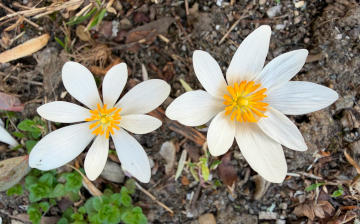
PHOTO COURTESY OF GARRY KESSLER
Bloodroot in mid-April
April 17, 2026
NATURE NOTES
By Annie Reid
Westborough Community Land Trust
Bloodroot – an early spring wildflower
“April showers bring May flowers,” or so the rhyme goes. We New Englanders might think of April differently, especially on a chilly April day with alternating moments of sunshine and . . . you know, snow flurries. The silver lining is that early spring woodland wildflowers start to appear in April. They’re otherwise known as “spring ephemerals,” due to their brief and fleeting existence above ground. Our native bloodroot (Sanguinaria canadensis) is an early sun-seeker, blooming in April into early May.
If you’re lucky, you’ll find bloodroot in the sunny, leafless woods or somebody’s garden. Look for flowers 3-6 inches high, 1-1/2 inch wide, with 6-12 fragile, bright white petals and golden centers. They often grow in patches, since they spread both underground and by seed.
The flower bud and a large leaf come up together, with the leaf wrapped protectively around the bud. This arrangement helps the bud survive whatever weather April might bring. The leaf has 5-9 lobes and opens fully after the flower does. The flowers open in sunlight but close at night and in gray, cloudy weather – a handy thing to do in April. How? Changes in water pressure inside the plant likely cause the opening and closing, in response to temperature changes from sunlight or from shade.
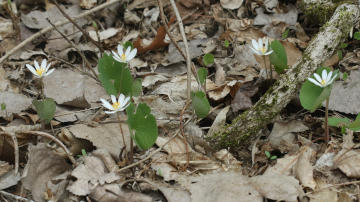
PHOTO COURTESY OF GARRY KESSLER
A patch of bloodroot flowers and leaves
What about bloodroot’s gory name? It comes from the red or red-orange sap and the color inside the underground rhizome, which is actually a horizontal storage stem that also produces roots. The sap is somewhat caustic. It probably discourages hungry woodland animals and insects from nibbling the leaves or digging up the thick rhizome.
Bloodroot flowers may last only a few days, or up to a week. They produce pollen but not nectar. Their white color is conspicuous in the brown and gray woods, but who’s around to notice and pollinate them? Many insects come, but bumblebees are their main pollinators. These sturdy bees are large and hairy enough to be active in chilly or windy weather. What if bloodroot flowers don’t get pollinated? Self-pollination may be possible due to the flower’s reproductive parts – stamens (male) and pistil (female) – being close together.
As the flowers fade and go to seed, that first leaf keeps enlarging, and more leaves sprout from the base of the plant. They can grow to 8 inches wide. Their job is to soak up energy from sunlight for food-making (photosynthesis) as long as they can. When the woodland trees leaf out in mid-May, that supply of energy is largely cut off by shade. During summer, bloodroot’s leaves die back and disappear. The plant goes dormant but lives on as the underground rhizome. It lies about an inch deep in the soil, and is about a half-inch thick and about 4 inches long. It stores the carbohydrates made by photosynthesis for next spring, to fuel early blooming. Such is the life cycle of a spring ephemeral.
As a native wildflower found throughout the eastern U.S. and southeastern Canada, bloodroot (or blood-root) has been familiar to people for centuries. It’s had a host of common names: puccoon, red puccoon, red root, Indian paint, snakebite, tetterwort, sweet slumber, turmeric, coon root, corn root. Bloodroot is in the poppy family (Papaveraceae).
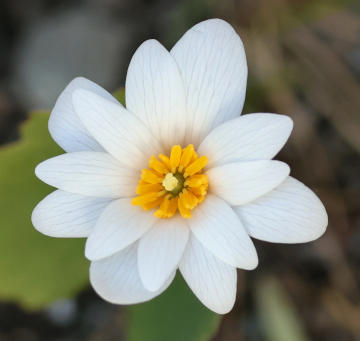
PHOTO COURTESY OF GARRY KESSLER
A double bloodroot flower
Similarly, people have put bloodroot to many uses, though not as food. Why not? Its caustic sap contains a toxic substance called sanguinarine. It can be poisonous if consumed in large quantities and is considered unsafe by the U. S. Food and Drug Administration. The sap can also irritate the skin. Ants, however, like to eat certain fleshy outer parts of bloodroot seeds. As a result, ants spread the seeds when they carry them to their underground nests and later discard them in underground tunnels.
Bloodroot’s red-orange sap stains readily and has long been used as a dye. Native Americans dyed baskets and clothing with it, and colonists used it to dye wool. Native Americans made war paint by mixing the sap with animal fat. The sap has also served as an insect repellent.
Beyond these practical uses were numerous medicinal uses. The sap was a treatment for ringworm (a fungal infection of the skin). It was also used to remove warts. To treat sore throats, Native Americans are said to have put a tiny amount of the sap on a lump of maple sugar and let it dissolve in the mouth. Native Americans made a root tea for rheumatism and lung problems such as asthma and bronchitis. The tea was also used for fevers, coughs, and more.
At one time, sanguinarine was included as a plaque-fighting ingredient in some commercial toothpastes and mouth wash, but this use has long since been discontinued.
Bloodroot is well suited for a partly shady spot in a New England garden. A double form of bloodroot exists, with more petals and an earlier blooming time (by a week or two) than the regular form. Apparently, the doubles (Sanguinaria canadensis multiplex, Sanguinaria canadensis florepleno) are all descendants of a single odd plant discovered in the mid-west in the 1950s. The doubles tend to be largely sterile because the extra petals are modifications of what otherwise would be pollen-bearing stamens.
Enjoy looking for bloodroot this season. You might also spot other native spring ephemerals blooming in the spring sunlight of New England’s woods. They include: marsh-marigold; windflowers; wild oats; goldthread; Northern downy violet; marsh blue violet; birdfoot violet; and dwarf ginseng.